

SCROLL DOWN TO READ THIS IN ENGLISH
A LABRE, como parte das comemorações de seu 92º aniversário, promoverá transmissões de imagem em SSTV a partir do satélite UmKA-1 (RS40S). As transmissões ocorrerão do dia 06 de fevereiro ao dia 09 de fevereiro de 2026 e uma imagem especial relativa ao aniversário de 92 anos da LABRE será transmitida em todo o mundo. Aqueles que conseguirem decodificá-la farão jus a um Certificado Especial, concedido pela LABRE. O evento é aberto a Radioamadores e também aos radioescutas. Ou seja, não é necessário ter um indicativo de Radioamador para participar.
O satélite UmKA-1 (RS40S) transmitirá na frequência 437,625 MHz (atenção ao efeito Doppler!) no modo Robot36. As imagens recebidas devem ser enviadas por este link.
- Início das transmissões: 06/02/2026 00:30UTC (05/02/2026 às 21:30 horário de Brasília)
- Fim das transmissões: 09/02/2026 00:30UTC (08/02/2026 às 21:30 horário de Brasília)
- Intervalo entre transmissões: 3 minutos
- Frequência: 437,625 MHz +- doppler
- Modo: Robot-36
Regras
Para ter direito ao Certificado SSTV LABRE 92 Anos, as regras são as seguintes:
- Receber a imagem transmitida pelo satélite exclusivamente via rádio, seja equipamento portátil ou fixo, com decodificação por software (smartphone, tablet ou computador). Não é permitido o uso de WebSDR (recepção indireta);
- A imagem recebida deve estar com pelo menos 50% de qualidade, ou seja, ao menos metade da imagem precisa estar legível, a critério da LABRE.
- Deve ser enviado o arquivo original gerado pelo programa de decodificação. Não é permitido nenhum tipo de retoque, correção ou edição;
- Formatos aceitos: JPEG, PNG ou BMP (bitmap);
- Enviar o arquivo com a imagem recebida exclusivamente pelo sistema fornecido pela LABRE. Não será permitido o envio por outros meios;
- Não é permitido o compartilhamento de imagens. Cada participante deverá realizar sua própria recepção, decodificação e envio do arquivo para poder receber o Certificado;
- Prazo para envio: até 48 horas após o final das transmissões.
Como receber os sinais
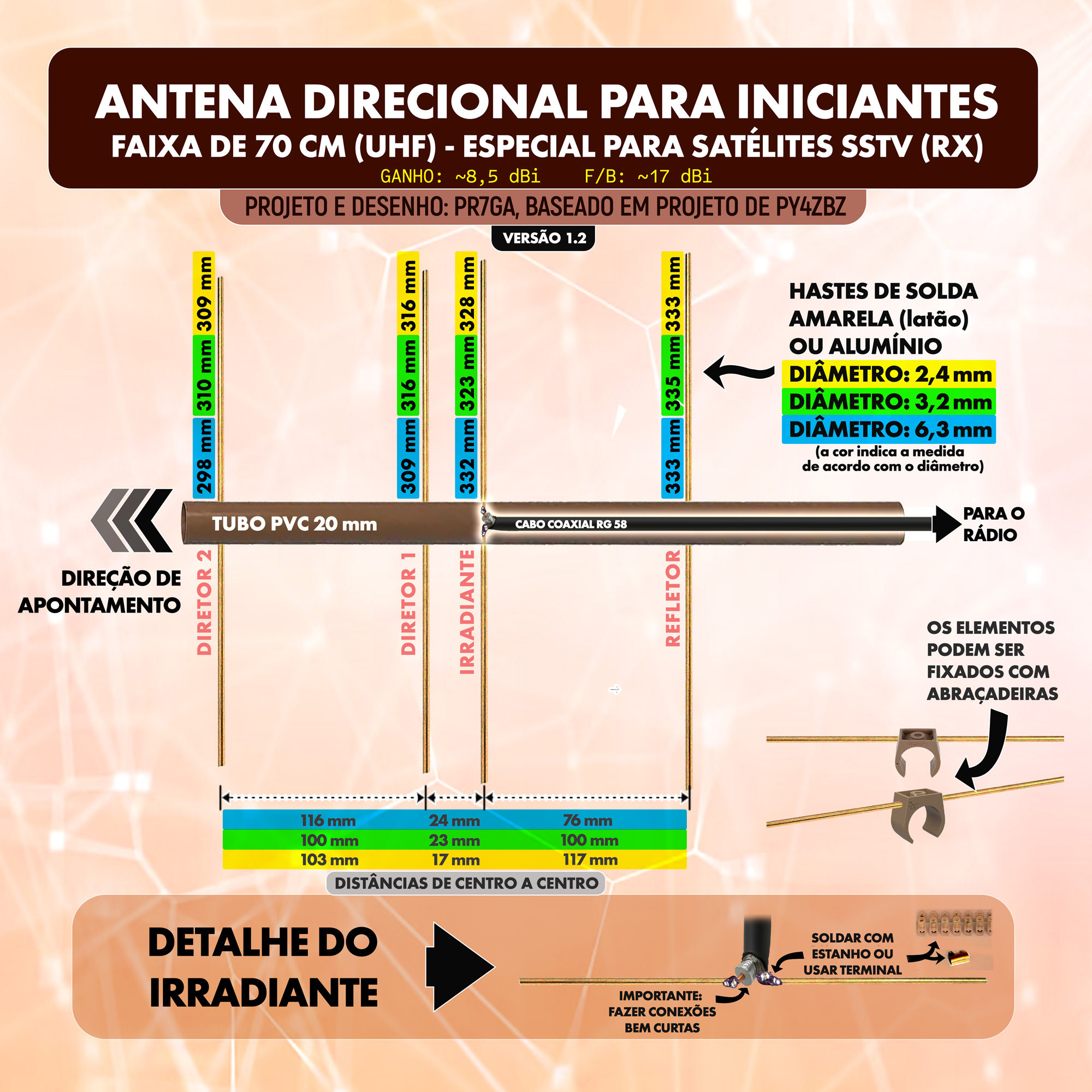
Rádio e antena: Como trata-se de um satélite de baixa potência, será necessária a utilização de uma antena direcional para que os sinais possam ser captados a contento. Sugerimos a utilização de uma antena direcional simples como esta:
Pode ser utilizado desde um HT simples, como os da marca Baofeng ou similares, até rádios fixos.
Para decodificar os sinais, a forma mais simples é instalar o app Robot36 em um smartphone ou tablet Android e, com o app aberto, aproximar o rádio do equipamento. O app decodificará automaticamente a imagem quando os sinais estiverem sendo captados pelo rádio.
Finalmente, como trata-se de um satélite de baixa órbita (LEO), é preciso utilizar um aplicativo ou outro sistema de rastreamento para determinar os dias e horários em que ele passará na localidade do participante. Cada passagem dura não mais que 10 minutos, a depender da órbita e posição do satélite no céu. Felizmente aplicativos como o Look4Sat ou o ISS Detector fazem este trabalho e entregam essas informações sem nenhum esforço.
IMPORTANTE!!!
A LABRE envidará todos os esforços para a realização plena deste evento. Contudo, é sempre bom lembrar que o evento poderá ser cancelado no todo ou em parte devido a problemas técnicos e operacionais, a cargo dos mantenedores do satélite UmKA-1 (RS40S). Caso isto ocorra, a LABRE informará em seu site.
LABRE 92 Years SSTV Event – Special Certificate Available
LABRE, as part of the celebrations of its 92nd anniversary, will promote SSTV image transmissions from the UmKA-1 (RS40S) satellite. The transmissions will take place from 2026-02-06 to 2026-02-09, and a special image related to LABRE’s 92nd anniversary will be transmitted worldwide. Those who successfully decode it will be entitled to a Special Certificate issued by LABRE. The event is open to Amateur Radio Operators as well as SWL. That is, it is not necessary to hold an amateur radio call sign to participate.
The UmKA-1 (RS40S) satellite will transmit on the frequency 437.625 MHz (attention to the Doppler effect!) using the Robot36 mode. The received images must be submitted through this link.
- Start of transmissions: 2026-02-06 00:30 UTC
- End of transmissions: 2026-02-09 TBD
- Interval: 3 minutes
- Freq: 437.625 MHz +-
- Mode: Robot-36
Rules
To be eligible for the LABRE 92 Years SSTV Certificate, the rules are as follows:
- The image must be received from the satellite exclusively via radio, using either portable or fixed equipment, with decoding performed by software (smartphone, tablet, or computer). The use of WebSDR (indirect reception) is not permitted;
- The received image must have at least 50% quality, that is, at least half of the image must be legible, at LABRE’s discretion;
- The original file generated by the decoding software must be submitted. No retouching, correction, or editing of any kind is allowed;
- Accepted formats: JPEG, PNG, or BMP (bitmap);
- The file containing the received image must be submitted exclusively through the link provided by LABRE. Submission by other means will not be allowed;
- Image sharing is not permitted. Each participant must perform their own reception, decoding, and file submission in order to receive the Certificate;
- Submission deadline: up to 48 hours after the end of the transmissions.
How to receive the signals
Radio and antenna: As this is a low-power satellite, the use of a directional antenna will be necessary in order to properly receive the signals. We suggest the use of a simple directional antenna such as this:
You may use anything from a simple handheld transceiver (HT), such as Baofeng or similar models, to fixed radios.
To decode the signals, the simplest method is to install the Robot36 app on an Android smartphone or tablet and, with the app open, bring the radio close to the device. The app will automatically decode the image when the signals are being received by the radio.
Finally, since this is a low Earth orbit (LEO) satellite, it is necessary to use an application or other tracking system to determine the days and times when it will pass over the participant’s location. Each pass lasts no more than 10 minutes, depending on the satellite’s orbit and position in the sky. Fortunately, applications such as Look4Sat or ISS Detector perform this task and provide this information with minimal effort.
IMPORTANT!!!
LABRE will make every effort to ensure the full realization of this event. However, it is important to remember that the event may be canceled in whole or in part due to technical and operational issues, at the discretion of the maintainers of the UmKA-1 (RS40S) satellite. Should this occur, LABRE will provide notice on its website.